
On 30 July 2026, the EU opened formal procurement for up to seven AI Gigafactories, large-scale facilities designed for the full model lifecycle from development through large-scale inference. The plan combines up to €10 billion in EU and national support with at least €20 billion in expected private investment. Award decisions are expected in early 2027, with deployable capacity to follow. Eligible AI SMEs and startups can already apply for compute through the separate AI Factories programme.
EUROHPC/2026/OP/0008. The single-stage open procedure closes on 12 November 2026 at 16:00 in Luxembourg (CET).What did the EU formally open for AI Gigafactories?
The call selects consortia that will establish and operate the facilities. EuroHPC and 18 participating Member States will jointly procure compute access time from the selected operators, giving the projects an anchor customer before construction. The call covers two consecutive development phases and two lots.
A Gigafactory can occupy one site, several sites inside one Member State, or a distributed cross-border deployment. The seven-project ceiling is separate from the number of physical locations because one selected project may span several sites. Consortia and special-purpose vehicles may apply, bringing together companies, public entities, investors and other partners. Funding and Tenders Portal procurement documents.
| Lot | Maximum projects | Maximum EU support per project | Phase-two accelerator scale |
|---|---|---|---|
| Lot 1 | Up to 4 | €100M in phase one, plus up to €400M in phase two | At least 75,000 H100-equivalent advanced AI accelerators (about 3× the current JUPITER benchmark) |
| Lot 2 | Up to 3 | €200M in phase one, plus up to €800M in phase two | At least 100,000 H100-equivalent advanced AI accelerators (about 4× the current JUPITER benchmark) |
Source: tender specifications (2026).
Funding framework: European Commission announcement (2026).
What will an EU AI Gigafactory contain?
Regulation (EU) 2026/150 defines a Gigafactory as infrastructure for the complete lifecycle of very large models and applications, from development to large-scale inference. That includes compute, storage, networking, secure cloud access and specialised AI support, backed by sustainable energy and water systems.
The tender specifications divide the service into three layers: managed infrastructure, a managed AI and MLOps platform, and ready-to-use model or application APIs with trust and compliance services. The third layer is aimed particularly at SMEs and public administrations. H100-equivalent is a normalised capacity measure in the tender, not a requirement to buy a specific NVIDIA model.
AI Factories are available now: Playground, Fast Lane or Large Scale?
Existing AI Factories offer access to EuroHPC supercomputers and technical support while Gigafactories are still being procured. Eligible AI SMEs, including startups, can apply for no-charge compute for innovation under the Industrial Innovation track. Other industrial applications can use paid commercial access. Academia and public-sector applicants have a separate science and collaborative projects track. The EuroHPC access-mode overview sets out those routes.
All three industrial modes apply country and organisation eligibility checks. The applicant organisation must be established or located in an EU Member State or an eligible programme-associated country; the applicable programme depends on the selected system. The March 2026 terms of reference define the full conditions.
These allocations support model development. EuroHPC's December 2025 access policy excludes production use and prioritises training or fine-tuning; inference should use only a small, justified share of an allocation. Agent teams still need a production inference service and application runtime for live workloads.
| Playground | Fast Lane | Large Scale |
|---|---|---|
| For new users, small experiments and testing code on the target system. | For teams familiar with high-performance computing (HPC), with a workload ready to run. | For larger AI projects that can justify the resources and use them efficiently. |
| GPU hours: fixed 5,000 on currently listed systems. | GPU hours: up to 50,000; the current system table sets a 10,000 minimum. | GPU hours: more than 50,000, subject to system limits. |
| Allocation: 1, 2 or 3 months. | Allocation: 1, 2 or 3 months. | Allocation: 3, 6 or 12 months. |
| Published turnaround: within 2 working days; rolling applications. | Published turnaround: within 4 working days; rolling applications. | Published turnaround: within 10 working days after a cutoff. |
Sources: EuroHPC's 2026 call pages and system tables for Playground, Fast Lane and Large Scale. Each application targets one system. Playground and Fast Lane require eligibility and technical assessment; Large Scale adds expert review and ranking. Published turnaround times do not guarantee an award or immediate job execution.
The 15 September cutoff and current capacity limits
Checked on 11 September 2026, the Large Scale call is marked Open. Its next cutoff is 15 September 2026 at 10:00, labelled CET by EuroHPC. This is a review cutoff in a continuous call; the following listed cutoff is 30 September 2026. Confirm the deadline in the submission portal before applying.
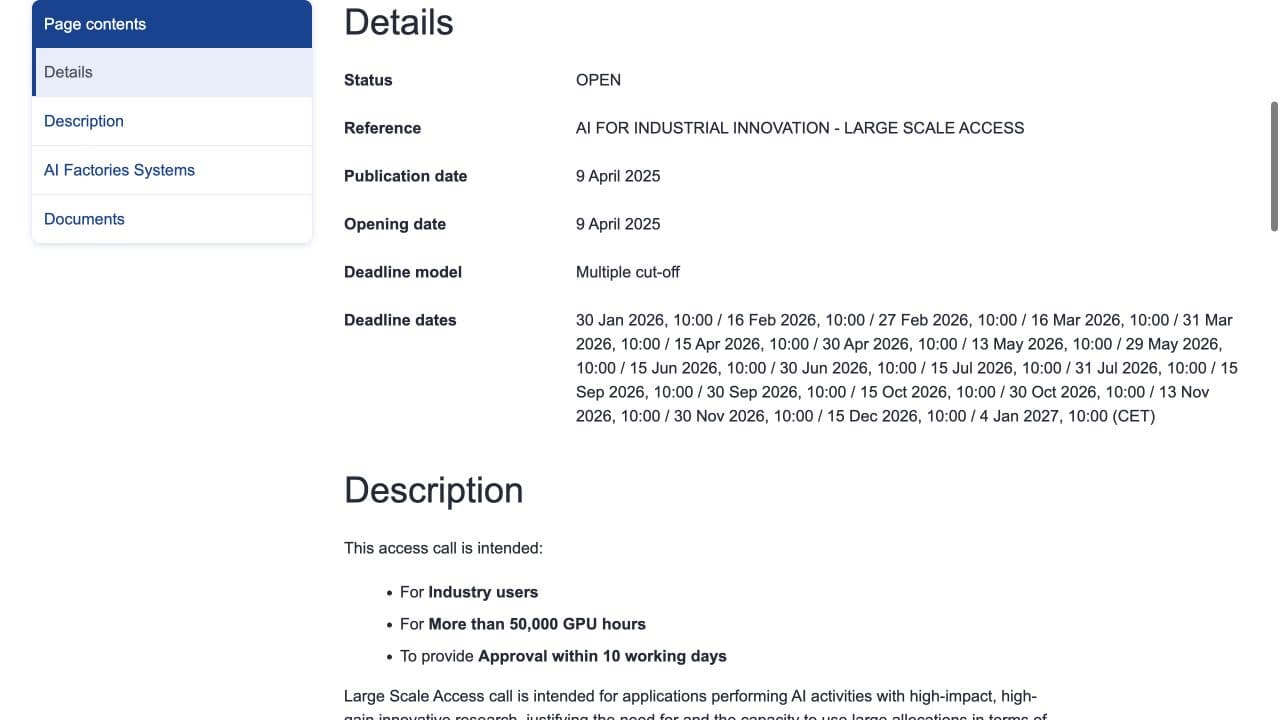
Capacity is restricted even while applications are open. On the same date, Large Scale lists MareNostrum and LUMI-G as unavailable for new allocations. The Fast Lane notice separately excludes MareNostrum5 ACC. Other partitions may also be full when an application is submitted. Check both the call notice and the selected system's resource limits before planning around an allocation.
Prepare a Large Scale application for 15 September
Check eligibility for the selected system. Prepare the organisation's VAT number and Participant Identification Code (PIC) where applicable. Confirm that the project lead's employment contract runs until at least three months after the allocation ends.
Choose one available system. Estimate GPU hours, storage and monthly resource use, then fit the request within that system's limits and an offered allocation period.
Write the proposal in English. Explain the innovation, expected impact, technical readiness and why a smaller system is insufficient. Include the project plan and ethics self-assessment. EuroHPC recommends testing code through Playground first.
Check the publication, confidentiality and final-report obligations in the terms of reference. Complete and submit the application through the EuroHPC peer-review portal before the cutoff; an unfinished draft is not considered.
A team still testing whether its code runs on the target hardware can start with Playground. An HPC-ready project within Fast Lane's limits can apply on a rolling basis. Neither route requires waiting for the Large Scale cutoff or for a future Gigafactory to open.
Who are the AI Gigafactories intended to serve?
The bidders are infrastructure consortia
Applicants need the financing, data-centre capacity, power, technical plan and operating model to build one of Europe's largest AI facilities. The coordinator must be incorporated, headquartered and controlled in the EU, and each hosting entity must sit in an EU Member State. Evaluation covers technical quality, security, sustainability, ecosystem impact and financial viability.
The users are broader than the bidders
The Commission names start-ups, scale-ups, SMEs, industry, academia and public authorities as intended users of training, fine-tuning and inference capacity. Public funding buys a proportional share of access time. Under the regulation, Union access is free for public-law entities, qualifying EU-funded research and innovation work, and private innovation by SMEs and scale-ups. Larger enterprises may use the facilities, but their commercial prices, quotas and service terms have not been published.
The hardware supply remains global. Suppliers may come from Europe or like-minded countries, and the Commission has signed letters of intent with AMD, NVIDIA and Qualcomm. Those letters are not supply contracts. EU-governed infrastructure describes control, jurisdiction and access; it does not require an all-European component stack.
When could AI Gigafactory capacity become available?
The call closes on 12 November 2026, and EuroHPC expects award decisions in early 2027. Framework and specific contracts would follow, after which construction could begin during 2027. Selected facilities then have a maximum of 18 months after contract signature to start operating. Signature dates remain unknown, leaving enterprise availability without an exact date.
What changes for enterprise AI teams?
The procurement creates a European capacity pipeline backed by public anchor demand. That demand arrives before the facilities exist and reduces part of the financing risk for operators. Most deployment teams will use models, inference services and fine-tuning products built on the resulting capacity; direct supercomputer allocations will be less relevant to them.
Which enterprise questions remain open?
The procurement sets facility scale and governance. It leaves the service surface to the selected projects and later access rules. Enterprise teams still need answers on model catalogues, API interfaces, fine-tuning workflows, regional availability, pricing, quotas, support and service-level agreements.
AI Act duties depend on an organisation's role and the system's use and risk classification; GDPR duties depend on the personal-data processing and the controller-processor relationships involved. An EU-hosted endpoint answers only part of either analysis. Map where prompts, traces and retrieval data are processed, and review every configured provider, tool, guardrail, judge and external destination together with the contracts governing third parties. Map every data plane before calling an agent stack EU-resident.
We want Connic agents running on European infrastructure
We are excited that the formal Gigafactory definition includes inference and services deployment. The procurement focuses on compute; Connic focuses on the agent layer that turns model calls into production workflows. Connic is based in Munich and contracts through a German entity. Projects can use an EU deployment region, and every connic/* model request runs on EU inference capacity.
Teams can connect an OpenAI-compatible endpoint under a Project provider prefix. Connic's tool, trace and approval plumbing remains available when the endpoint changes. Update the model configuration where needed and rerun tests because model capabilities and behaviour can differ. If selected Gigafactory operators expose compatible production services, that is the kind of European capacity we want Connic agents to use.
This article does not announce a Connic bid, award or integration with the Gigafactory programme. Our ambition is to help make new EU-native model and compute options usable as governed AI agents, close to European data and operational requirements. our European agent platform's data boundary and custom inference endpoints.
A complete map of the model, runtime, tools, traces, and external destinations prepares workloads for new European compute capacity.
Discuss EU deploymentWhat can enterprise AI teams do now?
Frequently Asked Questions
Methodology and disclosure
Connic publishes this analysis and has a commercial interest in European AI agent infrastructure. Procurement facts were checked on 14 August 2026 against the Commission announcement, the Funding and Tenders Portal and binding tender specifications, the live EuroHPC call, and Regulation (EU) 2026/150. Expected early-2027 award decisions should identify operators and projects; locations and service plans may remain open. EuroHPC call status and deadline.
AI Factory access terms, system limits, call status and cutoffs were checked separately on 11 September 2026 against EuroHPC's access pages and March 2026 terms of reference. The comparison and application checklist are Connic's summary; the screenshot records the official page on that date. Availability can change before submission.